By obtaining Spanish citizenship, you open for yourself the opportunity to freely choose your place of residence and work in any EU country, enjoy high standards of social protection, education and medicine.
With Spanish citizenship you become the owner of the right to free movement, official employment, access to prestigious education and a developed system of social protection.
Spanish citizens can visit more than 160 countries of the world without visas, including all the countries of the EU and Schengen zone, as well as the USA, Canada and Japan.
Holders of a Spanish passport can freely apply for a job, open a business and officially earn money in the EEA countries.
Citizens are entitled to free or reduced tuition at leading universities in Spain and other EU countries, and can also participate in international educational programs.
Spain offers its citizens extensive social guarantees: access to quality medicine, pensions, unemployment benefits and other types of state support.
Spanish citizenship is automatically passed on to children, providing them with a wide range of rights and freedoms from birth.
The Spanish passport gives access to the European market, allows you to open companies without restrictions, invest in real estate and take advantage of tax advantages in Spain and other EU countries.

Spanish citizenship can be obtained in different ways depending on the personal circumstances and legal status of the applicant.
Foreign nationals who have been legally residing in Spain for at least 10 years may apply for citizenship. It is necessary to prove knowledge of the Spanish language, a stable income and no criminal record.
Foreigners who are officially married to a Spanish citizen can apply for citizenship after one year of joint residence in the country. Additionally, it is required to comply with the conditions of integration – knowledge of the language and impeccable reputation.
There is a shortened naturalization period for some groups: refugees can apply after 5 years of residence, and citizens of Latin America, Andorra, Philippines, Equatorial Guinea and descendants of Sephardic Jews – after only 2 years.
If a child is born in Spain to a foreigner who at the time of birth did not have a local passport, he or she may obtain Spanish citizenship if at least one of the parents was legally resident in the country at the time of the child’s birth.
Fill out the form to be given a detailed consultation
Although the specific nuances of the process depend on the chosen basis, the basic steps to obtain citizenship remain the same. Precise compliance with legal requirements at each step is essential to achieve the result, and expert support greatly simplifies the process.
A comprehensive assessment of your situation is carried out: the length of time and reasons for residence in Spain, current legal status, family circumstances and professional activities are analyzed. Based on the data collected, an individualized plan for obtaining citizenship is formed. Lawyers identify possible obstacles in advance, determine the best solutions. This approach helps to avoid unnecessary delays, reduce the number of corrections and increase the chances of successful completion of the procedure.
The necessary package of documents is selected depending on the grounds for citizenship. Standard dossier: application form, valid passport or other identity document, birth certificate, certificates of criminal record from all countries where the applicant has lived, as well as certificates confirming proficiency in Spanish (DELE exam) and knowledge of the basics of the constitutional system of the country (CCSE exam). Special attention is paid to the proper execution of documents: translation into Spanish, notarization, legalization or apostilization. Lawyers accompany the process at every stage, carefully checking the dossier for compliance with legal requirements.
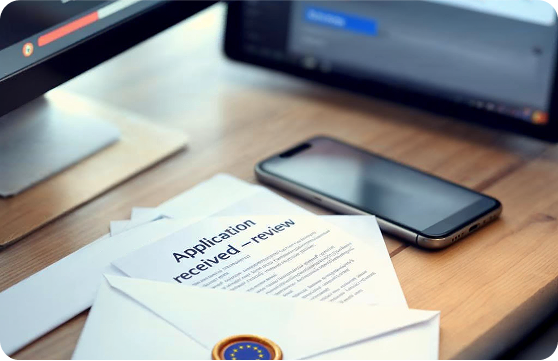
The completed application package is sent by the lawyer to the Spanish Ministry of Justice. According to the legislation, the time period for the application review is up to one year, but in practice it may vary. If the decision is positive, the applicant receives notification of the granting of citizenship. The next step is to officially renounce the former citizenship (if required) and take an oath.
After all procedures are completed, the new citizen can obtain a national ID card DNI, (Documento Nacional de Identidad) and a passport (Pasaporte). To do this, it is necessary to go to the appropriate police station, provide identification, a current photograph and pay the state fees. In addition, it is recommended to register with the tax authorities and obtain a Tax Identification Number (NIF), which is required for employment, business and access to public services.
At the first meeting the lawyer analyzes your documents, discusses your goals and selects the best option for EU citizenship.
The specialist independently collects the necessary certificates, organizes their translation and notarization in accordance with legal requirements.
The lawyer by power of attorney submits your documents to the state authorities of the EU country, ensuring the correct execution of the dossier.
We control the review process, notify you of a positive decision and accompany you during the final citizenship procedure.
Once you become a citizen, you will be issued a national ID card, passport and other European documents.
Leave your contacts to be contacted as soon as possible
To obtain citizenship through naturalization, it is necessary to live in Spain for at least 10 years legally. But there are simplified ways that do not require such a long stay in the country.
Yes, you must pass two exams: one for Spanish language skills (DELE) and the other for knowledge of Spanish culture and laws (CCSE). The DELE exam must be at least B1 level, while the CCSE test requires a basic awareness of the political and social structure of Spain.
In most cases, Spain does not allow dual citizenship, so the applicant will need to renounce previous citizenship when accepting Spanish citizenship. However, for citizens of some countries, such as Latin America, it is possible to retain dual citizenship.
No, the issuance of golden visas was canceled at the beginning of 2025.
The citizenship application process can take an average of a year, depending on the complexity of the case and the workload of the migration authorities.
The basic set of documents includes an application form, a valid passport or identity document, birth certificate, certificates of criminal record from all countries of residence, certificates of language, history and cultural knowledge.
Contact a lawyer to find out which EU passport option will be suitable for you.
Dunajska cesta 167, pisarna 37,
Ljubljana, Slovenia
Oregon Park – Șoseaua Pipera 46, 077190 București, Romania