With a German passport, you can live and work freely in any EU country. You have access to quality medicine, prestigious education and comprehensive state support.
By obtaining German citizenship, you open up unlimited opportunities within the European Union. A German passport provides free entry to EU countries and allows you to live, study and work in any of them without obstacles.
A German citizen can travel, live and work in any country in the European Union without the need for a visa or work permit.
German citizens are entitled to access to one of the best healthcare systems in the world, as well as a robust social security system.
Access to public and private educational institutions of the European Union is granted to Greek passport holders on equal terms with EU citizens.
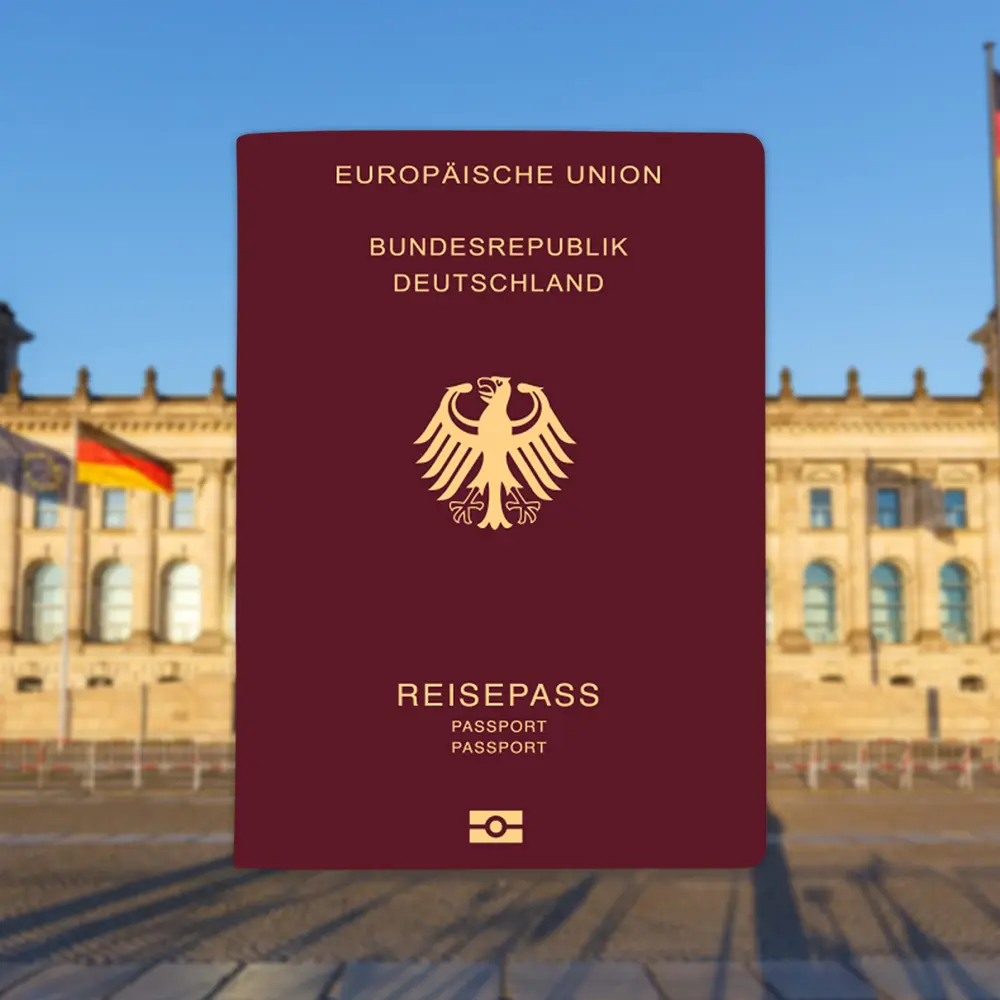
The German passport is among the most "powerful" in the world, granting visa-free or simplified entry to many countries, including the United States, Japan, Canada and Australia.
Higher education at public universities in Germany is often free even for those from other EU countries, and for German citizens it offers stable access to high-level studies without financial barriers.
Citizenship makes it easier to start a business, access government support programs, and participate in investment projects both domestically and across the EU.
German citizenship can be passed on to children, providing them with the same benefits. In addition, you receive strong legal protection not only in Germany but also abroad.

German citizenship is only possible if you fulfill a number of requirements. Different groups of foreigners are eligible for this status, depending on their life path and their degree of integration into German society.
Foreigners who have been legally residing in Germany for at least 5 years can apply for citizenship. The prerequisites are German language proficiency at least at B1 level, financial independence, no criminal record and willingness to abide by the democratic principles of the state.
Foreign citizens who are officially married to a German citizen or citizeness can take advantage of an accelerated procedure. This requires: at least two years of marriage, three years of legal residence in the country, and meeting standard language and integration requirements.
There is a simplified procedure for ethnic Germans, their descendants and those whose ancestors suffered persecution during the Nazi era (in particular Jews and their descendants). In these cases, a separate procedure is applied that takes into account historical justice and cultural ties to Germany.
Fill out the form to be contacted for a consultation
German citizenship is a highly regulated process that requires careful attention and observance of all formalities. Competent support at every stage helps to avoid delays and successfully obtain a passport.
At the first stage, a detailed analysis of your situation is carried out: the biographical data, the existence of grounds for citizenship (naturalization, marriage, repatriation and others) are considered. Possible risks and ways to prevent them are also assessed. As a result, an individualized action plan and filing strategy is formed.
A personalized dossier is prepared, including application, identity card, family status documents, language certificates, income and integration certificates. Depending on the basis, additional papers may be required. All foreign documents are subject to translation and legalization. The lawyers will take care of contacting the authorities, collecting certificates, notarizations and final verification of eligibility.
The complete set of documents is submitted by the lawyer to the responsible authority – usually the Ausländerbehörde, Bürgeramt or Federal Administrative Office (Bundesverwaltungsamt). After submission, the review of the application begins. If approved, the applicant is invited to an oath ceremony, which he or she is accompanied by a lawyer. After that, the applicant officially becomes a German citizen and receives the corresponding certificate.
At this stage, the application for ID card and passport is submitted to the Bürgeramt together with the lawyer. A photograph, ID card and citizenship certificate are required. You can also apply for a tax identification number – this is useful for employment, business and opening a bank account.
At the first meeting the lawyer analyzes your documents, discusses your goals and selects the best option for EU citizenship.
The specialist independently collects the necessary certificates, organizes their translation and notarization in accordance with legal requirements.
The lawyer by power of attorney submits your documents to the state authorities of the EU country, ensuring the correct execution of the dossier.
We control the review process, notify you of a positive decision and accompany you during the final citizenship procedure.
Once you become a citizen, you will be issued a national ID card, passport and other European documents.
Fill out the form to be contacted as soon as possible
The standard period is 5 years if you have successfully integrated (language skills, stable income, no criminal record). In certain circumstances, for example, if you have a German spouse or outstanding merits, the period can be shortened.
Germany does not now require you to renounce your previous citizenship. You can keep your passport and apply for a German passport as a second passport.
The minimum requirement is a B1 level on the Common European Framework of Reference. This is confirmed by an official language certificate or a certificate of completion of an integration course.
Yes, the citizenship test (Einbürgerungstest) is required for most pathways to citizenship. It consists of 33 questions on German history, law, culture and the foundations of democracy. You must answer at least 17 of these questions correctly to pass.
The timeframe depends on the region and the workload of the office, but on average the procedure takes between 4 and 12 months. If there are additional requests or complications, the waiting period may increase.
Yes, minor children can be included in the application of the mother or father. In addition, children born in Germany to foreign parents are automatically entitled to citizenship if certain conditions are met (for example, if one of the parents has been legally living in the country for at least 5 years but has not yet been able to apply for citizenship).
Contact a lawyer to find out which EU passport option will be suitable for you.
Dunajska cesta 167, pisarna 37,
Ljubljana, Slovenia
Oregon Park – Șoseaua Pipera 46, 077190 București, Romania